September 12, 2006

The Great Transformation by Karen Armstrong


Karen Armstrong is a former nun who renounced her vows and is now a prolific writer on the subject of religion. Some of her other works include A History of God and Islam: A Short History. Her work always display an incredible breadth of knowledge as well as very insightful analysis. While this results in books well worth reading, it often makes those same books difficult to read because of the sheer volume of information she puts into them. Her latest book, The Great Transformation, has both of those characteristics as well.

The title of "The Great Transformation: The Beginning of Our Religious Traditions" is, in short, what this book is about. To those who believe in a the literal truth of the creation story (whatever the religion), the answer to that is obvious, of course. However, in actual fact the great religions of the world, including those of the so-called Judeo-Christian tradition as well as Buddhism and Hinduism, are really artifacts of ancient human make. However, they did not arise out of a religious vacuum, nor did they arise quickly. The questions this book seeks to answer are, what conditions did those religions arise out of and why did they arise?

Armstrong seeks to answer these questions in a chronological format, giving the history of the era (thus answering the first question) as she builds to an answer for the second. She covers the time, roughly, between 900 BC and 200 AD (although she chooses to use the contemptible CE terminology). The history of the era is one of great violence and turmoil. Peoples were on the move, and empires rose and fell, shattering the idea of permanence. To people who had belonged to state-centric religions, where the religion reflected and supported the "natural" order of kings, priests, and people, when the empire fell the religion was no longer valid. Without religion, they had nothing to affirm their existence, and needed a substitute. Animists, of course, wouldn't be troubled by this, but even most animist traditions relied on the idea of permanence.

Armstrong chooses to focus on four spiritual centers: Greece (more specifically Athens), Palestine (the land, not the country, obviously), India and China. While this seems simple enough, the picture is actually rather complex. Naturally, one may wonder what great religious tradition arose out of Greece. The answer is none. Their answer to the problems of the Axial Age was not religious in nature, although it was at times also spiritual and philosophical. The religions or spiritual traditions that did arise are quite numerous, more than the easily remembered Judaism, Buddhism or Confucianism. All were attempts to face the uncertainties of the world, and all attempted to find a way to live at peace with an un-peaceful world.

The bulk of the book details the developments of these religions in parallel with events in history. I felt that she made quite adequate arguments demonstrating how and why these developments were responding to outside events. That's one of the best reasons I could give for suggesting this book to readers. To my knowledge there is no other book that covers that territory for more than one religion, and it's quite enlightening to see them developing in parallel. It gives one a much more solid grasp to be able to place history in context than as an isolated incident.

The title might lead one to think that this book talks about the early days of each of these great religions. That's the last thing that she gets around to, and takes up the least time. I suppose many people don't know that religions don't just pop out fully formed, like Athena from Zeus' head. The religion of the Hebrews in the Bible (or Torah) was nothing like the rabbinic Judaism of today. Armstrong takes much more time explaining to us the Judaism of the prophets than in describing rabbinic Judaism (presumably because the reader is either more familiar with it already or there are many worthy books about precisely that). Her concern is mainly the gradual mutation that ends in these final religions or philosophies, and she stops basically where they have become at least the rudimentary version of their final forms.

All in all I think the book is well worth reading. Although she makes an attempt to draw a conclusion at the end that the stale religions that focus on doctrine rather than understanding and which assert that only their knowledge is the correct knowledge are useless and detrimental, she really doesn't spend too much time on that theme either, although it is certainly a worthy and interesting assertion. And yet of a four-hundred page book, the conclusion is only ten pages long. Perhaps she's saving that for yet another book.

All in all, I say read this book. It's challenging, to be sure, but in the end quite rewarding as well.

September 10, 2006

Terrorist by John Updike


Terrorist is the story of a teenage boy in New Jersey who is enlisted into a plot to carry out a devastating attack on America. Ahmad Mulloy Ashmawy is the son of an Arab father (who abandoned them) and American mother (of Irish descent). He grows up devoutly religious, not through any effort of his mother's but for some ambiguous reasons the auther fails to fully identify. All the other characters are essentially worthless to the plot, even the school guidance counselor, Jack Levy, who gets almost as much time as Ahmad.

Evidently a lot of people love this man's writing, but they must be loving something else because this book is about worthless. Forgetting the issue of PC-ness he broaches by having an Arab-American as the terrorist of the title, it's just not very likely. Other reviewers have said that he chose this character as his instrument to reflect on the state of America today, and his origin serves solely as a plot device to cause his disaffection with this society. But I think if that's the case, it's a weak and unnecessary device, given that there are plenty of Americans who are as disaffected and more prone to violence than some half-Arab New Jersey teenager. As a matter of fact, although it's a topic not often discussed, the main terrorist threat in America comes from white Christian extremists. These people aren't even theoretical; they've actually been responsible for real terrorist acts all over the United States.

Be that as it may, Updike is one of the least astute character writers I've ever read. If anyone reading this doesn't like that assessment, I suggest picking up Dostoyevsky's "Crime and Punishment" or "The Brothers Karamazov". Now that's some character writing. I just felt like he endlessly described people's outsides and never touched their insides. It's a book, which means that you have the ability to show the reader the thoughts and feelings of a person, but not to adequately depict their facial expressions or colorations (in other words, it's not a picture). And yet he rarely took the opportunity to get inside anyone's mind, even the main character Ahmad's. And what little internal narration he did give Ahmad was pretty much the same thing over and over again. As for the other characters, he may have intended them to be mockeries of real people instead of making them real people, but if he was doing that I certainly didn't pick up any hints of satire to clue me in. The whole book was dead serious, and dead boring.

I tend to lump all books into two main categories: they're either about the characters or the plot. Given that the characters were such a failing in this book, you might be tempted to think the plot redeems it in some way. You would be wrong. The story itself advances slowly with about three-fourths of the book being wasted in unnecessary build-up (which would be fine if there were decent characters, but as it is...). The climax is so anti-climactic it actually made me sleepy. There's absolutely no payoff in the end.

If you're a fan of this guy, perhaps this book could work for you. For me, it was an unfortunate reading choice and a complete waste of time. If you want to read books about domestic terrorists that are just as implausible but a lot more exciting, pick up Tom Clancy.

September 05, 2006

Road Work by Mark Bowden


This is a sort of compendium of shorter works by Mark Bowden (journalist and author, most famous for Black Hawk Down) comprised of 19 stories on a variety of topics. As an example, he covers the issue of torture, a small bio of Saddam Hussein, the historic rivalry between two high school football teams, the genetic engineering of cattle, and even the story of the world's oldest living gorilla. There's something for everyone there.

I think Mark Bowden is a great journalist, because he writes the kind of in-depth stories that I like to read, and if you've read Black Hawk Down, you know he's a master at keeping personal bias out of it. Some of these stories are more personal though, and call for that kind of personal commentary, so you do get a different experience here than in a longer work like Black Hawk Down.

This is a good book if you want to read some non-fiction but don't want to commit to a 400 page book on one single topic. If you're the kind to get bored to tears by non-fiction but you still want to read it sometimes, this is the book for you. Not only are the stories short and entertaining, Bowden is a solid writer.

I suggest you pick this up at the library and give it a try. You may just find you want to read Black Hawk Down after all.

August 29, 2006

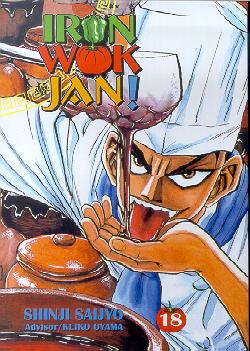
Iron Wok Jan by Shinji Saijyo


Jan is a young chef who has been trained in the art of Chinese cuisine by his grandfather. When the story opens, he has just been released from training and sent into the world of Chinese restauarants (in Japan) at the restaurant of his grandfathers's old friend, Gobancho. Jan doesn't inspire much friendliness in the staff because his motto is "Cooking is about winning", i.e., proving that he's better than all the other chefs in the world. He has major clashes with the owner's grand-daughter, Kiriko Gobancho, and the third young chef-in-training, Celine Yang. Neither of them appreciate his elitist attitude, nor his disdainful way of treating them.

I like this book mostly because it's funny. Although they go into great detail about a ton of different recipes and kinds of food and culinary secrets, that's not the main attraction. Jan is dead serious about cooking, and the book takes it seriously too. But I like when there's comic relief, especially when Okonogi comes up with yet another crazy dish, like spring rolls with appetizers stuffed inside.

I have to admit this isn't the best manga out there, and it's not something I'd usually read, but it's actually got a compelling story and the characters have just enough depth to make them worth reading.

August 16, 2006

Fight Club by Chuck Palahniuk


Fight Club is one of my favorite books of all times and certainly is my favorite book by Chuck Palahniuk. In my opinion, it's much more enjoyable than most of his later works (although Choke and Lullaby were also good) because in this one, the gross-out factor of the material never went higher than the laugh factor. For example, in Fight Club, Tyler Durden has a penchant for using body fluids as ingredients for diners at fancy restaurants. It's nasty, but I don't eat clam chowder anyway. In contrast, in Haunted, a woman's newborn is turned into soup and in another scene a woman ends up eating part of her own ass. Actually there is no humor in those moments. It's just horrifying. So for me, Chuck has fallen off track a bit, but that's never dampened my enjoyment of Fight Club.

For those of you who have never read the book or seen the movie (and if you're in that category, what the hell is wrong with you?), it's really simple. An unnamed narrator has issues. He meets a guy on a flight and they end up staying at the same house. They form the fight club in question, which is what it sounds like: a club where men fight. Not boxing, just plain old streetfighting. The narrator's life starts to spiral out of control as Tyler goes on to plan bigger and better things (namely overturning society and instituting a new world order). It all comes to a head in the end. There's a woman in there as well: Marla, who I have to say is the best female love interest ever.

A lot of people have talked about this book as if it's either a crime against humanity or one of the most important works ever written. Of course, there are plenty who just don't care and then there are tons of fanboys who completely don't get what Chuck was trying to say but think they do. A lot of feminists have railed against it for its "misogynistic" tendencies, which shows that they missed the point. The book, in short, is about men who go wild precisely because they don't know how to be men. The narrator's initial rejection of Marla isn't misogyny, it's self-hatred (is that automisanthropy?). In the end, when he's figured himself out and overcome (or killed) his Durden-self, he can then reach out to her have the normal relationship. If Palahniuk was being misogynistic, he would have killed Marla and the narrator (or Joe, or Jack, or whatever you want to call him) would have become Tyler.

On the other hand, while I enjoy this book immensely because of Chuck Palahniuk's originality and freshness, I don't think this is the key book of the 90s. It might be the key book of the displaced male at the end of the century, and I certainly identified with it, but in the end it's best not to subject it to too much psychoanalytical scrutiny. It certainly has some Nietzchean overtones, but it doesn't quite fit the mold as well as Star Wars fits the Campbellian "Hero With a Thousand Faces" model.

In a lot of ways, it's just a teen book for grown-ups, especially men, about a guy who has completely lost his way but finds it in the end after a lot of misadventures. What makes the book great is not that the subject itself is so bold and new, but that Palahniuk simply wrote the best story about it that I've ever seen. I mean, if you want books about people finding their true selves that are also male-oriented, check out The Kite Runner or I Know This Much is True. I wouldn't say Fight Club is a better book than either of those, but it's certainly shorter and a better read most of the time. And it's funnier and has more action. I think Fight Club works because it's a book that says the same stuff, but it's less cerebral about it. Look at the title. Two words express the entire book, whereas you get nothing from the titles of the other two. In short, Fight Club is the non-thinking man's version of that kind of story. The fact that it has such an impact on so many men is kind of disturbing. I mean, if it moved these guys so much, surely The Kite Runner would have them weeping on their knees at the end!

Movie Adaptation

Now this is definitely one of my top five movies ever. It's got all the goodness of the book, but also the incredible visual direction of David Fincher. He completely understood where it was coming from, and this is one time where I thought the entire cast was just great. Edward Norton always does a great job as far as I'm concerned, but I'm not such a fan of Brad Pitt. And yet he was one of the highlights of this movie. Not only his acting, but they gave him such a great look as Tyler. And it was exactly how I thought Tyler might have looked. And Helena Bonham Carter as Marla. Just perfect. The score by the Dust Brothers was one of the few where I thought electronic music perfectly complemented the movie.

Somehow, Fincher managed to stay true to the book while keeping the movie flowing smoothly along. There really isn't any wasted time in the movie. If you have the dvd, take advantage of the commentary from Fincher, Norton, Pitt, and Carter. Unfortunately hers was recorded separately, but the guys are hilarious when they're talking about whatever they're seeing, plus which it's just a bonus for fans of the movie to hear about how certain shots and such were arrived at.

July 31, 2006

Edward Gorey

Edward Gorey was a writer/illustrator whose work is probably more well known than his name. You may recognize this image:


That's an illustration he did that was used in the introduction of the PBS "Mystery" series. I saw that a long time ago, but that was all I knew of him. Mildred is a big fan of his and has several of his books. They're rather interesting, but I think "gothic" is definitely the best way to describe them. He liked dark and random humor. Anyway, it's not my point to tell you all about him; that's something Mildred should do. I just want to say that there is a very interesting online store dedicated to him and his work and like-minded creators.

I like a lot of the things you can find on there, like this:


There are these really cool "haunted portraits" that change from one image to another. They are not those crappy holographs you see everywhere else. Check them out here. This is one example. It's really cool.

July 29, 2006

Nightmares and Dreamscapes (from the stories of Stephen King) on TNT

When you hear that any Stephen King story is being made into a tv movie, it's natural to think to yourself, "Oh god, how are they going to ruin it now?" And usually, you find that it's the same old combination of a low budget and bad director. However, if you've been watching this mini-series of one-hour episodes from the book of the same name, you know that strangely enough, they actually did a good job this time. If I'm not mistaken, every episode has had a different director and they've had different casts. And they've had a decent budget. I've been really impressed and I thought that all the episodes thus far were really good. I'd watch them again and I hope they come out with a dvd soon. So far, "The End of the Whole Mess" has been my favorite, but I think all of them have been good. Not only that, but the shows have been really faithful to the written stories. I still remember them, and a lot of the dramatic points in "The Road Virus Heads North" were recreated in the show.

Suffice it to say, I'm happy so far and that's a really strange occurence in general with King on tv. He has had some successes. I mean, the Dead Zone has been a real success, but a lot of the tv movies just sucked. "It" was passable, but "The Tommyknockers" was just ridiculously bad. I mean, it wasn't that great a book either, but still. And "The Langoliers", while having its moments disappointed me too. I can only hope that when someone decides to do The Gunslinger series, they make a commitment to doing it well. If that one goes bad, I'll have to hurt somebody.

Reefer Madness: Sex, Drugs, and Cheap Labor in the American Black Market by Eric Schlosser


This is another great book by Eric Schlosser (you may remember him from Fast Food Nation). As the title says, it's about the sex industry, illegal labor, and drugs (only marijuana though). It's a lot like FFN in that it's an expose of industries you don't really know that much about besides the hype and lies that their opponents publicize about them.

His first subject is the marijuana trade. Schlosser gives a long and detailed history of the use and abuse of marijuana in this country. Most people probably don't know that at one time it (like most other drugs) was legal, and even fairly commonly used. Schlosser talks about plenty more that most people probably don't know about, like the incredible harshness of laws against people who are convicted of growing or selling it, as well as the scientific debate over the true effects of marijuana on a person's health. What may come as a shock to many is that it is widely acknowledged by scientists (even government appointed panels) that marijuana is much less dangerous a drug than alcohol, with less harmful side-effects and no evidence of life-threatening conditions caused by abuse (liver failure for alcohol vs. possible chronic bronchitis for marijuana). Despite knowing this, certain lawmakers and prominent people continue to push for harsh regulation of the drug for their own political reasons. I'll spare you the details because if you want to know more, that's what this book is for.

The second section, and the shortest, is about illegal labor, and thus illegal aliens. This is a section that really has the emotional punch. There's no way you can not sympathize with the guys he talks about; the ones who are responsible for the profits of so many farmers (and a significant chunk of California's economy) who at the same time are treated as second-class humans, and while being exploited by their employers are punished by America's laws. One of the things you might learn from this book is that these migrant laborers are nothing new; they've provided most of the muscle for farmers in the West since those states have been part of the US. The only thing that's new is that we made them illegal. While a lot of politicians and pundits talk about these people competing with native-born Americans for low-wage jobs, the truth is that those low-wage farming jobs have never been a source of income for most Americans. The only time there were a lot of native migrant farm laborers was in the Dust Bowl era. And that phenomenon ended when the that period did. Well, there is one other new thing occurring: more industrial employers are taking on illegal immigrants as laborers because they will work in illegal conditions (and if you know how far the protections of OSHA have fallen, you know that's really bad). Aside from farms, illegal immigrants are now working in meat-packing plants, the most dangerous job in America. Injuries and even death are common in those plants (a subject discussed more thoroughly in Fast Food Nation). I can almost guarantee you that after reading this book, you won't be asking why we're not doing more to keep illegals out; you'll be asking why the people who use those laborers aren't in jail.

The third part of the book deals not with the sex industry exactly, but rather the porn industry (including adult films, books, toys, etc). As Schlosser tells it, that basically boils down to one man: Ruben Sturman. If you've never heard of the name, that's not surprising. This was a man who had imaginary people as heads of companies that actually did business for him, and almost none of the money went through traceable means to him. Really, this is a story of a decades-long conflict between a businessman and government regulators. Sturman himself was no Hugh Heffner or Larry Flynt. He didn't indulge in his own product or have a promiscuous sex life. He only visited the set of one of his movies, and left because it was boring. He was eventually caught for tax evasion, but in the end I could hardly fault him for hiding his money from the government when they went after him on obscenity charges obsessively. When you hear how many times and ways they tried to prosecute him, you'll think it's ridiculous too. Along the way, you find out how he built an empire of porn from coast to coast (from Cleveland, of all places!) and how it reflected the fight between the government pornographers.

What's really funny is that although they finally caught him on tax evasion, that investigation was only started because they were trying to catch him on obscenity charges, something the federal government had been trying to do since he distributed "smut" books (stuff that's practically tame compared to the paperback romances we have on the shelf at the library). By the time they caught Sturman, Larry Flynt had won his fight over the constitutionality of porn and there were adult theaters open all over America. For a long time, they'd tried to claim that "adult bookstores" were somehow connected to the mob, but Sturman has always denied that charge and federal investigators of the mafia also rejected that idea. I think this section is interesting for the human story, but also because it details the rise and spread of pornography in America. Something that might surprise you in this section is Larry Flynt's prediction that if porn is freely available, people will stop wanting it. Sounds strange, but there are some numbers from Denmark to back that up (or some country, if I'm forgetting the right one).

That kind of parallels another argument he made about drugs. Evidently Spain and Portugal have legalized drugs and evidently are showing a decline in usage (as well as drug crime). I don't enough to say more about that.

In the end, Schlosser wraps up with his recommendations (legalize marijuana, let people have their porn, and criminilize the employers of illegal aliens, not the immigrants). The book's parts, while all reflecting illegal or shady sides of the American economy, have little in the way of a unifying theme. The introduction of the book talks as if this is more of an economic study on those segments and hands out some numbers and statistics. While these are certainly interesting and in-depth discussions of some important issues, they're really not economic studies, although he does talk about exactly how much money is represented in these industries (and it's a freakin' huge amount of money).

Schlosser is a fairly good writer, but he's more of a journalist type than Morgan Spurlock is, so you have to expect it to be quite a bit drier. While it's always enlightening and interesting, I'm not sure I'd call it entertaining exactly. This is a pretty heavy book (figuratively, that is), and I don't recommend it as casual reading if you're only going to pay half-attention to it. But I do strongly recommend taking the time to read it and appreciate it properly. At the very least, people need to know what he says about marijuana and illegal immigrants. So there it is. Read it!

July 19, 2006

"The Assassin's Gate" by George Packer


Iraq is a place of terrible sadness and terrible hope.

That at least is the lesson I take away from reading Packer's book, about the American invasion and occupation of Iraq. I found his book to be highly educational, engrossing, saddening and deeply moving. Packer does more than offer just an overview of the history of the invasion and the present occupation; rather, he attempts to get in the heads of both principle actors and ordinary people, Iraqi and American, swept up by the war and it's aftermath. In that way, he gives us a picture of Iraq, and ourselves through the lens of Iraq, that is as complete as it can be in one book.

Packer's book is divided into four different section. In the first, he talks about the run-up to the inavsion. This story we are mostly familiar with, as a result of countless news and magazine articles and interviews detailing the failure of the Bush administration to understand what they were getting us into, and plan accordingly for the consequences. But Packer takes us deeper into the motivations of those who planned the war, into the incredible insularity of President Bush and the willingness of the neo-cons in the administration to deny the complex realities of Iraq to further an airy ideal of democratization, while at the same time justifying to the public the need for invasion on national security grounds that they themselves didn't accept or were simply uninterested in. Through him we see how those in the administration deliberately avoided planning for the aftermath of Iraq, believing that to do so would weaken their case for war and that it was entirely unecessary anyway. The neo-cons sincerely, honestly believed that a relative handful of Iraqi exiles, many of whom hadn't been in Iraq in decades, could lead the democratic revolution they had in mind, install a new government in a span of months that would be friendly to America as a result of the liberation, and allow us to pull our troops out before the end of the year.

Packer glosses over the invasion, and for good reason, as many would probably agree that though the initial invasion was the turning point for everything, it's also dwarfed by what's happened since. Instead, the next section of his book takes us inside first the Office of Reconstruction and Humanitarian Assistance led by Jay Garner, then the Coalition Provisional Authority under L. Paul Bremer. The failure of the ORHA is well documented; after all, Garner wasn't replaced after only a few months because he was enjoying wild success. But the simple truth is that Garner and the ORHA were set up to fail. They were not tasked with doing what would be necessary in Iraq after the invasion, because nobody believed that anything other than acting as a caretaker until the exiles could come to power was necessary. The looting and chaos that followed the invasion resulted in a quick change of plans, the sacking of Garner, and the creation of the CPA. But the CPA was also hampered by the failure to plan for the post-invasion period; planning was done on the fly in Iraq and in the Washington, and the officials working for the CPA, famously insulated from the world of Iraq around them, made decisions that seemed arbitrary, or uninformed, or capricious to the Iraqi people. Pronouncements were made that were aimed to the Americans back home, but real progress on the ground was hampered by key strategic mistakes such as widespread de-Baathification at the behest of the exiles and the neo-cons, economic changes put in place by young men and women from such places as the Heritage Foundation or the AEI, and the decision to completely disband the Iraqi army, a decision made seemingly by Bremer himself without any historical justification or guiding princples.

Far removed from the Green Zone, we then see a portrait of an American captain working on the ground with the Iraqis to furhter the reconstruction. Unlike the ideologues in the CPA, or even senior commanders in Baghdad or the Pentagon, American soldiers on the ground were interested only in what worked. How should they deal with the Iraqis? How can local government be reconstituted? Where can they get the money for reconstruction projects? American soldiers faced the double task of trying to fight a burgeoning insurgency without alienating the Iraqi populace, while at the sime time scraping for funds and equipment to do things they were never trained for like build schools or hold local council elections. Nothing if not resourceful, many of our soldiers did they best they could with what they could get their hands on, even as they began to die in greater and greater numbers.

But perhaps the most engrossing part of the book is the part about the everyday Iraqis themselves. Packer talks to Sunnis and Shiites, Kurds and Turkommen, former Baathists and former resistence fighters, the religious, the secular, insurgents and members of the militias, men and women. Through it all there emerges of a portrait of an Iraq that is chaotic, violent, backwards, but yearning for change and who all seem to start out cautiously optimistic about the future, though each Iraqi he talks to seems to have a different idea of what that future should or will be. But at the same time it is moving and saddening to read about how the violence worsens with each of Packer's return trips to Iraq, and how his Iraqi colleagues and friends begin to grow more and more fearful of the future, and more fatalistic, more resigned to a future of bloodshed, fighting, and chaos as Iraq begins to tear itself between the Kurds, Sunni insurgents and jihadists, and increasingly brutal Shiite militias. As you read, it's as if you can feel the hope draining from them, and their resignation as they realize they are trapped in a land that is still defined largely by the ways in which Saddam Hussein terrorized, brutalized and divided his own people to maintain his power.

The most painful chapter to read, "Memorial Day", is the story of a father who has lost his son, a private in the U.S. Army, to the war in Iraq. It is agonizing to read not only about the father's pain, but his unending questions about the war in Iraq that he is constantly asking. In an email, he candidly and honestly puts these questions to Packer, and to himself:

October 4, 2004: What is best for America and Iraq? That is the question. A better Iraq? Is it possible? Why did we go into Iraq? What justifies our remaining? American lives have been lost, precious lives, for what? Can something be achieved that is worthy of the sacrifice? Are there things not known to anyone other than the President and his advisors? No one in the Senate or any of the "attentive" and "informed" organizations? That would justify the sacrifice? And how much more sacrifice can be justified? For us to turn Iraq over to civil war would be hard to take. I don't have the right to advocate continued involvement because of my sacrifice that would lead to more, many more. What is best for America and Iraq? What is reality on the ground in Iraq? What is possible to achieve? Can Kerry and a team of his choosing do it? It is a great leap of faith. And most of the time none of this matters to me. I want my son. My son.


Packer doesn't have to say it, because it's clear from the fact that he included this and other agonized emails from the father. This father who lost his child in Iraq, is asking the questions that each of us should have been asking from the beginning, should have been asking this whole time, and should be asking ourselves now. The point is not primarily the answers, though we desperately need answers of some kind. The point is in the asking, because we can never even hope to come close to the answers unless we ask these questions honestly of ourselves, without consideration for which political party it harms or benefits. It shouldn't have taken the deaths of hundreds of soldiers to begin asking the questions, and it shouldn't require the deaths of thousands more to ask them in earnest now.

The book ends with the dissolution of the CPA and the national elections at the beginning of 2005, and Packer returns largely to the Iraqis that he's come to know to end his story. We see the elections were a hopeful event to many Iraqis, however they were interpreted by both sides here at home, but also that many Iraqis faced death to vote in a country that should have been well on its way to peace, and that many other Iraqis seemed willing to place themselves in the hands of Shiite political parties that want an Islamic theocracy that has little room for the Sunnis, secular Iraqis, and former Baathists. And as we've seen in the last year and a half, there are precious few ways in which anyone could say Iraq has gotten better. More and more Iraqis die, American casualties no longer make headlines because they're so common place, and hard-line Shiite militias seemed poised to wrest control of the country to themselves. Still, Packer's book gives us valuable lessons on what has happened-on what is happening-in Iraq, lessons that we can use now, lessons that we ignore at our peril.

Pick it up.

Misquoting Jesus by Bart D. Ehrman


I was surprised when I put this book on hold at the library and it turned out to have 7 people ahead of me on the list. The vast majority of non-fiction books, especially those about studies of Christianity do not tend to have the same kind of pull that books like the "Left Behind" or "Da Vinci Code" do. I figure this is an anomaly caused by the extreme popularity of Da Vinci right now. Otherwise, a book that talks about how the New Testament is in fact subject to human error might not get such great play.

Before anyone gets excited though, let me say that this book doesn't tell you anything new. It's a well-written introduction to the area of textual criticism for the layman, and it doesn't really tackle any of the major issues of that area of study. The bulk of it is just him talking about the categories of textual errors that occur and why they occur. Well, I guess some people actually don't know that much about it, so let me give a little history.

No one on Earth (at least, that we know of) has any of the original manuscripts of any of the books of the New Testament. Nor do we have any first-generation copies (that is, original copies of those first manuscripts), nor anything that was copied within 100 years of the originals. And there are precious few copies that go back before the time of an "orthodox" church. So we have the fewest copies from the earliest period and more as time goes on (up to today, when there's practically a bible for every person on the planet). Christian scholars have known all along that there are many variations among the copies of the books we have. As Ehrman puts it, there are more variations than there are words in the New Testament.

To bring it to the point, the idea of the Protestant church is that the Bible, being the divinely inspired word of God, serves as the infallible guide for belief. The problem, of course, is that the New Testament was written and re-written by human beings. Those who claim that the King James Version (or any other) is the "right" version are basing their beliefs on flawed translations of flawed copies and flawed translations. There is no version of the Bible today that can safely be said to present the unaltered texts as they were originally written.

Ehrman details exactly how such mistakes and deliberate changes were made, why we know they were made and how we can try to reconstruct the original wording. This is not a science unique to Ehrman, nor is this some kind of fringe movement. The field of textual criticism was founded almost 500 years ago when Protestant scholars tried to show validation of their religious beliefs by working backwards to the purest form of the New Testament possible. It has become fairly advanced at this point and involves scientific methods of reconstructing the texts, as well as using established criteria to determine what the older, more original version of a text was.

Ehrman discusses the different kinds of changes that were made, including the accidental and deliberate changes. An example of accidental change would be when a scribe copied a line over again without realizing it or miscopied a word (or miswrote the actual letters, something that happens when you're copying a language that's not native to you). He also points out some deliberate changes, those where the scribes were making a passage make more sense to themselves grammatically and theologically.

Ehrman's definitely a good writer, and I've enjoyed reading his books before, so if you're an Ehrman fan, it's definitely worth it. If you don't know anything about textual criticism, this is as decent a place to start as any. But, like I said, if you've read a dozen books that study the New Testament, you've more than likely heard everything that's said in this book. But if you're not that knowledgeable, read it!