March 30, 2012

After The Trail Of Tears: The Cherokees' Struggle For Sovereignty, 1839 1880


After The Trail Of Tears: The Cherokees' Struggle For Sovereignty, 1839 1880
After The Trail Of Tears: The Cherokees' Struggle For Sovereignty, 1839 1880 by William Gerald McLoughlin

My rating: 5 of 5 stars


What an amazing book! Histories of the Cherokee people tend to go up to the Removal and no further, as if Cherokee history ends at that point. Of course, that's not true. The Removal can possibly be said to be the most important single event in Cherokee history, although the event with the most damaging legacy is the passage of the Dawes and Curtis Acts collectively, as they illegally abrogated over two hundred years' worth of treaties between sovereign nations and ended the United States' recognition of the Cherokee tribe (as well as all others) as sovereign nations. Unfortunately, there are many, many fewer books about the Cherokee after the Removal than there are about the Cherokee before it.

This book goes a long way towards filling in the gap between the Removal and current times. As the title states, it specifically covers the years from 1839 to 1880 (the end date seemed rather arbitrary, but it was as good a place to stop as any). 1839 is the year that the Removal began, and although the author does cover it, it's really the starting point for McLoughlin's story of the Cherokee in their new homeland in Indian Territory.

For those who haven't read any Cherokee history whatsoever, this book may not be the best starting point. It doesn't absolutely require foreknowledge of major actors like The Ridge, his son John Ridge, John Ross, Elias Boudinot, Stand Watie and others of note, but it certainly is useful to have some of that knowledge even if it's only because it's easier to keep track of who's on which side. McLoughlin doesn't take a lot of time to build the back story, so it's probably not obvious why The Ridge was such a formidable leader and had so much influence even though he was never Principal Chief. Also, understanding the century and a half of Cherokee history (especially their dealings with white men) before the Removal would explain why there was a faction of Cherokees in favor of moving the tribe West.

In any case, the book quickly moves on to the efforts to rebuild the nation and deal with the factionalism that really only ended once the nation had been destroyed by the US in the early 1900s. Not only was the enmity between the Ross and Ridge factions deadly to members of both parties, it proved to be the focal point upon which the nation broke during the Civil War. But even aside from that, the early Cherokee settlers (those who had voluntarily moved as early as the 1820s) regarded the latecomers as potential usurpers of what they considered their established nation. Dealing with this degree of factionalism within the Cherokee nation consumed much of Principal Chief John Ross's time and efforts up until his death shortly after the Civil War.

McLoughlin covers this period of time in great detail. One of the best things about his book is that not only is he always talking about the national political situation, he gives an overview of what life was like for ordinary Cherokees at the same time. Obviously, the poor full-blood farmers had lost most of their possessions during the Removal and were expected to restart their lives as farmers in a new land that presented them with incredible challenges. They had been moved to worse farmland where the soil and vegetation as well as the climate were different from what they knew. They had no farm implements, no livestock, no seed, and not enough healthy people to put in all the work necessary even if they'd had the tools to do it. For a time they reverted to their oldest crafts, making earthenware pottery to serve and cook food in, as well as carving wooden utensils.

However, the Cherokee survived and prospered, eventually stabilizing and gaining some semblance of normality. Unfortunately, at the same time, the US was falling apart over the issue of slavery. Now, one of the lesser known aspects of Cherokee history is that there were Cherokee slave owners. The majority of Cherokees certainly did not own slaves, for the same reasons that most poor Southerners did not own slaves. Among the Cherokee however, there was no common feeling between the class of poor full-bloods and the richer (mostly) mixed-bloods (such was the common terminology at the time). When the US erupted into civil war, the Cherokee were caught between a rock and a hard place. The Cherokee Nation's leaders in the Ross Party and the majority of full-bloods (which means the majority of people) had no desire to side with the Confederate States. The reality, however, was that they had no power to resist the coercion of the Confederacy to side with them as the Union had no ability to project military power that far West and South at the time (or at least not the will to do it). In addition to that, the Ridge Party (led by Stand Watie, Ridge's nephew) was attempting to use John Ross's resistance to siding with the South as leverage with which to oust him from power, aided by the Confederacy. Ross decided that the only way to keep the Cherokee Nation in his party's hands was to at least temporarily side with the South. This may sound like a crass political ploy, which his opponents did accuse him of, but at the time the Ridge Party was petitioning the US government to separate the nation into two because they were tired of the "tyranny" of Ross and the full-bloods (this despite the fact that Ross was the representative of the majority). Ross saw this as a prelude to the destruction of the nation and determined that it would not happen. If that meant the nation had to side with the South in order to survive, he would do it. The Cherokee, as it happened, did not side with the Confederacy for long. Almost immediately after forming a couple of brigades, the one consisting primarily of full-bloods deserted. The anti-slavery, anti-Ridge Keetoowahs began organizing and fighting Watie's Confederate soldiers and supporters on their own. Eventually, Ross was willingly captured and went to Washington, where he affirmed that he'd only submitted to siding with the Confederacy under duress.

The Civil War, despite being a white man's war, split the Nation once again by reinforcing the division between the Ridge and Ross parties. This division, as well as the struggle to once again rebuild the nation, is the topic of much of the rest of the book. Eventually, as McLoughlin details, some reconciliation was achieved, but the Ridge supporters remained alienated from the leadership of the nation for the rest of the Cherokee Nation's history, right up until it was dissolved. Their original dislike for Ross stemmed from his staunch refusal to consider removal, which led to the treasonous Treaty of New Echota in 1835. After that, their contempt for Ross's government led to outright hatred when some Ross men (without his knowledge) assassinated Major Ridge, John Ridge, and Elias Boudinot. Not only were Watie and the other slave-owning mixed-bloods looking out for their economic interests when they sided with the South, they were seeking to use the conflict as a means to unseat Ross from power. When that was unsuccessful, after the Civil War their party morphed into opposition of the Downing government based on the fact that many of the wealthy mixed-bloods felt that their interests would be better served by some apportionment of the land and US citizenship, which naturally the full-bloods were dead-set against.

McLoughlin's book captures the complexity of Cherokee politics in this time wonderfully. He substantiates his arguments with plenty of evidence, and presents both sides in an unprejudiced light. This is exactly the kind of book that is necessary to give a counterbalance of all the stories of the Plains Indians during the same time period which is the image most Americans have of Natives post-Civil War. The story is not one merely of the inexorable expansion of Americans into Indian territory, but how the Indians dealt with whites all along as equals, or even as a method to gain influence in their own political systems. It is instructive and informative, and should be required reading for anyone looking to learn how Native societies deal with the encroachment of white societies.

The book's subtitle would imply that none of the history after 1880 is covered, but the author actually does go into a little bit of what happened up to the early 1900s. Obviously, as he says, the time of allotment and everything that happened during that is enough material for a book on its own (which unfortunately, he did not write), but he sketches out a rough image of what occurred. The story ends, basically, with the Cherokees left almost entirely landless, poor, and second-class citizens of a nation that didn't want them so much as it wanted their land.

All in all, this book is well-written, well-researched, and very, very informative for the student of Cherokee history. I highly recommend it.


View all my reviews

March 06, 2012

A Princess of Mars


A Princess of Mars
A Princess of Mars by Edgar Rice Burroughs

My rating: 4 of 5 stars


Well, that was really pretty good. Aside from some stupidity about how the Tharks became more bestial because of owning property in common (a fairly obvious reference to then current socio-economic theories advanced to explain why some people were "lower" on the scale of civilization) and talking about "savages" (aka Apaches) in the first part, the book was incredibly imaginative and so far ahead of its time it's a wonder that it hasn't been directly adapted into a movie until now. It's fairly obvious, however, that it inspired a lot of the sci-fi that came after it.

Burroughs may not have known that there was no possibility of life on Mars (or at least, nothing of that high an order), but he certainly didn't limit himself to what he thought might be possible. This is wildly speculative sci-fi here, and it's all the better for it. The story is not incredibly deep, nor is John Carter a very deep character. He's no cardboard hero though. What's surprising is how amorally he approaches just about any situation. Burroughs obviously wasn't concerned with character development, just a rip-roaring adventure story. In my eyes, he succeeded admirably at that.

Of course, this may not be enough for other readers, especially those who aren't fans of the adventure genre. I am, admittedly, a fan of things like Conan the Barbarian and Solomon Kane, so this book is definitely aimed at readers like me. It's certainly not high literature. The prose is never the kind of writing that would win awards. It's not awkward either, though, just serviceable.


View all my reviews

February 08, 2012

Bury My Heart at Wounded Knee: The Illustrated Edition


Bury My Heart at Wounded Knee: The Illustrated Edition
Bury My Heart at Wounded Knee: The Illustrated Edition by Dee Brown

My rating: 5 of 5 stars


All books are a product of their times, and some age better than others. The question is, despite its immense popularity, is this book still relevant? I hope to answer that question in this review.

Despite the books incredibly high marks from the vast majority of readers, there are those who strongly dislike this book, and I’m sure that’s amazing to most of the people who read this book because so many of them liked it so much. But it’s true, there are those other people.

Criticisms I’ve seen of this book include -

  • Too boring
  • Too repetitive
  • Too one-sided


It’s not really my purpose to go through and rebut each of these criticisms, but the reason I’m starting my review in this fashion is because I think each of these criticisms addresses both what people like and dislike about this book. Let me take each point in turn.

It’s too boring!
I can understand this point, although I don’t agree. Most histories involve a lot of details. Lots of place names the reader doesn’t know, which means they can’t relate to it. Lots of people names the reader doesn’t know, and more being added every few pages. And instead of building into a grand narrative, this book is just the same story over and over again. But the thing is, for each individual story, this book is a good history. Dee Brown really did his research. That’s why the book is bursting with details. I suppose that to some people, the more detail there is the harder it gets to read, whereas for others it adds flavor and depth to the history he’s telling. Personally, I’m in the latter camp, although I do get bored with histories sometimes. Of course some histories can be engaging, even humorous, at times. The style of the writers definitely varies from a “just the facts” voice to one that will paint a picture in the mind’s eye using descriptive vocabulary to give a more prosaic reading. Dee Brown, at least in this book, tends to be on the dry side, as far as prose. I believe the point is to allow the light to shine on the actors and events themselves, as well as providing a stark contrast between the author’s plain writing and the often much more lyrical voices of the actors in these events. I have not read any of his other books, so I really can’t offer an analysis of how he wrote. I will not say that I think everyone should enjoy his writing, but I do think people who complain of this book being boring because of the author’s writing need to find more patience. As for those who merely find the subject uninteresting, I guess it’s not for everyone.

It’s the same thing over and over again!
Well, yeah. I mean, that’s kind of the history of the American continent. White settlers wanted the Indians’ land and they took it by hook or by crook. The fact that this happened over and over and over again is no exaggeration, it’s just history. All well and good, you might say, but why go to great lengths to describe it over and over again? It’s all about the context. Back when this was written, books by White historians were still being written that described Indians as “savages”. And the American Indian civil rights movement really didn’t begin until the ‘70s, so when this book was written, the savagery, greed, and destructiveness of the White invaders had never been focused on before. It was important to demonstrate that what the colonizers had done was not atypical, that it had not happened just once or twice, and that it wasn’t the action of a few bad people. The point is, to the American Indian, history is the story of the Americans’ greed, racism, and genocide. Most Americans then did not (and most Americans now do not) learn much about American Indians other than that they had once been here. The only exposure most Americans got to American Indians at that time was through a bunch of racist, historically inaccurate movies. In light of the hundreds of years of racism suffered by the Indians and the decades of movies where they were the bad guys, the lesson that the real history was different would be a message that takes some repeating. This book is especially good for those who know nothing about the real history of the American Indian.

It’s biased against Whites!
Some people (pretty much White people) argue that this is a biased view of history, that it’s prejudiced against Whites, and more importantly makes them feel bad about themselves (no, they don’t say that last one out loud). In a sense these are valid criticisms. Not for the reasons White folk imagine them to be, though. As far as bias, it is. It is biased (in the sense of being weighted) towards seeing Native/Colonist interactions from the Native point of view. It’s not like there aren’t dozens of books written by White historians that either treat Indians like the “noble savage” or more likely, just “savage”. This book was explicitly meant as a counter to that bias, which is why its full title is “Bury My Heart at Wounded Knee: An Indian History of the American West”. One might argue that this approach is not the proper or most effective way of countering such a prevalent bias in histories of the American Indian, but this book is meant as a shock to the system, and is aimed squarely at lay-people who didn’t graduate with a BA in History (or anything else, for that matter). If they were only going to pick up one book about the history of White relations with Indians, let it be this one.

Should you read this book?
I have to say that anyone who’s even remotely interested in American Indian history, the state of American Indians today, or American Indian politics should read this book. Somebody who is going to try to be an expert on any or all of these issues should read this book because it is a good history of the areas that it covers, and because so many other people have also read it. Someone who isn’t an expert and isn’t trying to be should read it because this is an excellent counterpoint to the standard studies of American Indian history (what little there is of it) given in public schools. Indians didn’t just go away, they were systematically destroyed. Of course, some of us did survive and are still surviving today. But that’s a different book.

Final thoughts
The history of the American Indians is complex. It’s never as simple as it may seem at first, and authors can, unfortunately, give the wrong impression just by writing the facts a different way. I’m not going to call myself an expert, but I am a Cherokee who has an interest in the history of his own people, and having read many books on the subject, I know more than most people about it. In order to demonstrate how the same story can be told in order to give different impressions, I’m going to write two accounts of the Cherokee Removal.

Story 1) In the face of increasing pressure from the Georgians, Major Ridge and many other prominent chiefs decided that the only way to survive was to move west to Indian Territory. The US government was prepared to offer the Cherokee Nation some 3 million dollars in trade for the lands they would be losing, as well as to pay the costs of transportation and some goods for the displaced Cherokees to begin their new lives in Indian Territory. The chiefs signed The Treaty of New Echota in 1835, clearing the way for removal. Despite ratification by the US Senate, Principal Chief John Ross adamantly opposed it and falsely informed his people that they would never be forced to move. After years of stalling, the Cherokees were forced to move and because of the lack of preparation, an estimated 4,000 Cherokees died on the way to their new homes.

Story 2) After the discovery of gold fields within the Cherokee Nation, Georgian trespassers demanded the removal of the Cherokees. The Georgians were generally jealous of Cherokee prosperity, as well as their high standard of living (upwards of 90% of Cherokees were literate, whereas something like 15% of Georgians were). They pressured the US government to take the Cherokee land. Upon signing an agreement with a small number of men who were neither representatives of the Cherokee Nation nor representatives of a majority of Cherokee people, the US government claimed the right to forcibly remove the Cherokees from their lands, and did so in 1838 resulting in what is now called The Trail of Tears, which resulted in the deaths of over 4,000 Cherokee, mainly the elderly and young.

The truth is more complex than either of these accounts, but neither of them is untrue. The fact is that the vast majority of Cherokees were innocent victims of an absolutely brutal government. The other fact is that Cherokees were complicit in allowing the removal to happen. Maybe it would have happened otherwise, or maybe they could have survived Jackson’s tenure as President and gotten one more sympathetic to their plight. The Ridges didn’t believe that would happen, and they took such actions as they believed necessary to save what they could of the Cherokee Nation. The Georgians thought that land was wasted on “savage Indians”, which they were still calling us despite the fact that we hadn’t fought in a war since the Creek War, read newspapers, and generally did things our White neighbors did. The Georgians might have just formed a militia and starting slaughtering Cherokees anyway. Either way, we were the ones who made a choice. We weren’t simply passive victims.

Now you may ask, what’s all that got to do with this book? Well, I told you that I was going to try to answer whether this book is still relevant. I’ve read this book a couple of times now, and my opinion is still that it’s a great book. It just so thoroughly smashes the established idea of the West that no one who reads this can ever after accept stereotypical Hollywood Indians who sweep in to kill White men and take White women. It destroys the idea that the Indians came from nowhere to enact violence and went nowhere after the Whites came. It rips away the idea of the Indian as a wild creature who fought because he liked it and replaces it with the Indian as a soldier who fought for his land and his people.

The greatest disservice that Hollywood movies that portray Indians as villains and books that portray Indians as victims is that they don’t make non-Indians understand that Indians are real people too, who cover the entire range of the human spectrum. We had great and noble men like Sitting Bull, Crazy Horse, and John Ross. We had men who did horrible things like Geronimo and Doublehead. But they were all real men, with real men’s wants, desires, and feelings (not to mention all the women who are just left out). That’s why Bury My Heart at Wounded Knee is a beginning to the discovery of the American Indian as a real person. It should be read by everyone whose knowledge of American Indians comes from Hollywood or misinformed school teachers.

PS: Specific to the illustrated edition, the additional essays and pictures really add a lot to the experience. For anyone who’s only read the original version, or anyone who hasn’t read it yet, get this one.


View all my reviews

January 09, 2012

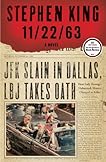
11/22/63 by Stephen King

11/22/6311/22/63 by Stephen King
My rating: 5 of 5 stars

Good god, this was an amazing book! I can't say for certain that it was the best of his I've ever read, but it may well be. I don't know what all to say, but damn, this book is just one of those that is going to stay in my memory for a while.

A lot of people equate Stephen King with horror (and perhaps the assassination of JFK could properly be regarded as that) but for his true fans, we know that he's far from limited to vampires, werewolves, and immortal extra-dimensional psycho-clown killers. I would say though, that this book, which can be regarded as sci-fi but might also fit into the historical fiction genre, is truly a breakout work, and is as far from horror as he is ever likely to get.

One of the things I have always liked about Stephen King is his ability to write characters. He usually manages to give them unique voices and interesting personalities. He certainly doesn't disappoint this time. Not only that, but the narrative just seems to flow so easily in this book. There's almost always a point in a King book where I wonder where the hell this is going and if all these words are really necessary, but there just doesn't seem to be any wasted space in this one. Not only does the narrative flow, this story is compelling! I rarely get so wrapped up in a book that I really don't want to put it down, but this is one of those times.

As a native Dallasite, this is the first book I've ever read that takes place in my home city, and it's more than amusing to see the names of streets I've driven dozens or hundreds of times. I have been to the 6th floor museum, seen JFK's memorial, and walked around the area. And of course, just driven right by it many times on my way elsewhere. Hell, I've even watched movies in the Texas Theater. Perhaps that makes this book resonate strongly with me because it does seem so real. But I think that any reader should get that feeling to some extent. The assassination of JFK is something that all of us are familiar with to a greater or lesser extent, and the names and places talked about in the book shouldn't seem strange or unknown to most readers. But even more than that, even if this was an entirely fictional book, it's so grounded in reality that it reads as a real event.

A lot of times, Stephen King gets in his own way with his narrative style. In other books (I remember a few particularly annoying instances in The Tommyknockers, my least favorite of his), his self-interruptions are so pervasive that what is meant to heighten feelings of dread and suspension simply destroy the flow of the narrative. King really doesn't do that in this book. Perhaps he likes to say "the past harmonizes" and "the past is obdurate" a bit too often, but even so it doesn't really get annoying.

Lastly, while I'm not entirely sure what a Texas accent sounds like to Mr. King, I am sure that he doesn't write it extremely well. Fortunately it's just words, not sounds, so it's just a source of amusement. The only other thing I noticed is that in a diner, the waitress asks George/Jake if he wants a piece of peach "pie" and I was like, what the hell is diner in Texas doing with peach pie instead of cobbler? Ok, I know there is such a thing, although nobody I know has ever made it for me, and I've never seen peaches made into a pie and I don't think I'd heard of such a thing until I Googled it after reading it in this book, but I can hardly believe that there would be peaches made into a pie in 1960s Texas.

Oh, and in the afterword he says that the Texas Theater is closed. This is not true. You can go there and enjoy some very unique films (indie and foreign) and catch some great live acts.

View all my reviews

Anathem by Neal Stephenson

AnathemAnathem by Neal Stephenson
My rating: 3 of 5 stars

Neal Stephenson strikes me as one of those writers who sometimes has fantastic (in both senses of the word) ideas but who sometimes has trouble making a really good narrative out of them. One of the things I'm sure many people complain about regarding this book has got to be the overly long explanation of some of the philosophies the characters in the book hold. I'm sure that to the author, it seemed necessary to explain some of these ideas in order for the reader to understand what was happening, but I doubt your average sci-fi reader (especially one willing to tackle a book of this size) really needs that much dialogue dedicated to explaining the mechanics of his plot device.

With that reservation expressed, I must say that I really did enjoy this book. The story really was a good one, and the characters were memorable and I think decently fleshed out. The plot doesn't move along quite as fast as it perhaps should (which is due to the flaw I already criticized) but the story does keep moving. He does have a good plot device and a good story around it. Perhaps not absolutely original, but some of his ideas like the "mathic world" are ones I haven't seen before, and at least interesting enough to bolster the story when it is in its slower parts.

I can't give this four stars because I feel that it did just have too much fluff. The author is prone to explaining too much, and this makes the narrator, Erasmas, seem just stupid sometimes. For example, using a paragraph to explain how a fish-eye lens distorts the image of anything seen right next to it is just too much. There are some other technical explanations that I won't bother detailing here because the author shouldn't have bothered detailing them there. I know not everyone reading this will be quite as familiar with astronomy or spaceflight as I am, but I would think most sci-fi fans who are up to reading this book wouldn't need such things laid out for them in quite such detail.

Final recommendation: read it if you're a big sci-fi or Neal Stephenson fan and you will probably enjoy it enough to make the time spent worthwhile.

View all my reviews

December 29, 2011

"Cherokee Tragedy: The Ridge Family and the Decimation of a People" by Thurman Wilkins


Cherokee Tragedy: The Ridge Family and the Decimation of a People (Civilization of the American Indian Series)Cherokee Tragedy: The Ridge Family and the Decimation of a People by Thurman Wilkins
My rating: 3 of 5 stars

Despite its lurid title, the book really focuses on the lives of Major and John Ridge. Any account of their lives is inevitably also going to be about the Trail of Tears, but this book chooses to focus mostly on the earlier parts of their lives, even going into details of John Ridge's marriage to his wife. Of course, given that these men were two of the most important Cherokee leaders of the day, much of the account is political in nature. The text can get pretty dry.

All in all, I'd call it a pretty good read, but I do have one big reservation about it. For some reason, the author felt the need to approach the Ross/Ridge divide as a partisan for the Ridges and he is unrelenting both in his defense of the Ridges and his criticism of John Ross. This bias got entirely too intrusive by the end of the book. Even if the author believed in the rightness of the Ridges' actions, he had no place fighting the Ross/Ridge battle in his book, which should have been an impartial history of the men.

Still, it's not a bad addition to the knowledge of anyone who's serious about knowing Cherokee history, so I'd recommend it.


View all my reviews

November 04, 2011

"The Cherokees: A Population History" by Russell Thornton

In contrast to my previously reviewed book, this is a thoroughly scientific, thoroughly unbiased study of the Cherokees.

  The Cherokees: A Population History (Indians of the Southeast)The Cherokees: A Population History by Russell Thornton
My rating: 3 of 5 stars

Also unlike the previous book, it's a very dry read, as it consists mostly of numbers. Unfortunately the scope is very narrow, not that that's atypical for an anthropological study. The book only covers enough history to explain how there came to be so many different groups of Cherokees beginning in the 19th century. He cross-indexes population points reconstructed from the historical record with major events or important periods of change in Cherokee history. As a student of Cherokee history, this is nice (and certainly a substantial contribution to the complete understanding of the Cherokee) but as a book reader, it's both hard going and a bit thin. It would have been nice if this was coupled with a study in changing subsistence patterns that was occurring as well.

 He has an interesting chapter about exactly who is a Cherokee in current times. It's a more complicated issue than it sounds like, and he has an interesting insight into why everyone seems to think they have a Cherokee grandmother.

 This is a work by an anthropologist, and it is basically for anthropologists and historians. If you don't have any anthropological background, or are looking for a general history of the Cherokee people, this will be even harder going than it is for those of us with that education. Still, it's worth checking out as it does add to the corpus of knowledge of the Cherokee people.

View all my reviews

October 27, 2011

"The Cherokees" by Grace Steele Woodward

Wow, I can't believe it's been this long since I last posted a book review! I'm still reading books, I guess I was just preoccupied with other things. Anyway, I've got a new one for you. I guess it's not really a coincidence that this one is also about Cherokees, since these poorly-written books keep angering me this much. Cross-posted from my Goodreads account: The Cherokees (Civilization of the American Indian Series)The Cherokees by Grace Steele Woodward
My rating: 1 of 5 stars

This book is a great example of the ethnocentric viewpoint that many sympathetic white Americans had towards Native American cultures, and which in some cases persists into current times. Up until modern times, there were very few people who accepted that Natives and Native cultures had the same right to exist as colonists and their self-labelled "white" culture. While there were plenty of sympathizers, their sympathy mostly took the form of trying to rid the Indian of his "savage" nature. "Savage" is a word that occurs many times in this book, always directed at Cherokees. Grace Steele Woodward's position is best exemplified by he of "Kill the Indian, and Save the Man" fame, Captain Richard Pratt.

This feeling of superiority, this ethnocentrism, is pervasive throughout the book. I'll give the final paragraph of the book as an example. The paragraph before this talks about the progress and achievements the Cherokees have made.

"But the coin has two sides. After statehood, full-blood Keetowahs retreated to the flinty hillsides and valleys in eastern Oklahoma, where they sought to keep alive ancient tribal traditions and by this method shut out reality. Eastern Oklahoma Cherokees have yet a long road to travel, if they are to overtake the more progressive members of their proud race. But they may yet throw aside their present lethargic habits, abandon their listless contemplation of the future, and, like Sequoyah, explore the unknown. For, given the proper incentive, no mountain, it seems, is too high to climb, no current too swift to swim, if one is a Cherokee."


I'm not going to list all the problems with that paragraph alone, but the sentiment should be clear enough. Whiter is better, and those people who choose not to blend in with white society have only themselves to blame for not being successful like their mixed-blood relatives. The book starts out similarly patronizing.

While this may not be as difficult a read for a reader who is not as sensitive to the insulting tone of the book, it makes for hard going for someone who is or is descended of one of those "full-blood Keetowahs" who "shut out reality".

Getting past all that however, the book does have some merit as a history. Unfortunately, not enough books have been written about Cherokee history for there to be a clearly superior volume to this one. Many of them deal with specific periods in history, notably the Trail of Tears (not that it shouldn't be written about and remembered, but seriously, our story's not over yet) or the American Civil War. And many of them don't deal with the earliest history. James Mooney's James Mooney's History, Myths, and Sacred Formulas of the Cherokees does deal with the early history, but his was written about 1900 and so leaves a large gap for any current reader. At least Woodward's carries on past the Dawes allotment act. While it actually ends in the early 1900s, she does mention some notable names in Cherokee history up into the 30s.

The main problem with the historical aspect of this book is that because it is biased, the author assumes some things that aren't or may not be true. She insists that the early Cherokee were savage and warlike, but the historical record does not support that the Cherokee were especially hostile. They welcomed English and French traders and there were no massacres to be heard of. This is not to say that the Cherokee were especially peaceful. They did their fair share of fighting. But this bias may mislead a less-informed reader to think that the Cherokee were especially warlike in comparison to their neighbors (both white and Indian), when this is not true.

As far as writing, the author isn't really a bad writer, but not especially compelling either. Her prose form is fine, but the fact of the matter is that a lot of explanations of events is lacking. She doesn't normally give birth and death dates for individuals, and often the reader loses track of what year is being discussed as her narrative can jump back and forth.

It should be noted that the author was not a scholar. The ethnocentric viewpoint she embraced as a writer was out of fashion in anthropology well before 1963. In the Journal of American Indian Education she was called "an energetic and gifted housewife". Her bio here notes a college education but not a degree, and not in either history or anthropology. Dedicated student of American Indians she might have been, but not a scholar. I don't say this to say that a lay person cannot write a good history, but that in this case it was obviously detrimental.

In short, I would not suggest this book as a starting point for learning about Cherokee history. Mooney, despite being old, is a good place to start, but there are plenty of more modern books about the Cherokee to read that take advantage of previous research and more modern methods.

View all my reviews

June 24, 2009

Another terrible book about Indians by white Christians

Cherokee Rose (A Place to Call Home #1)

This book is as bad as the cover looks. And that lady looks like Famke Janssen, not any Cherokee I've ever seen. This may not be evident from the cover, but this book is set before and during the Trail of Tears, which means the cover depicting some lady in possibly a Sioux dress out on the plains is just ridiculous, as Tennessee has no plains to speak of and Cherokees had their own clothes. The writing is horrible, the factual errors numerous, and the fact that this is a Christian book makes it even less believable. The first review on the Amazon page details some of the historical mistakes, but trust me, there are plenty more. In short, another terrible book about Indians written by white people.

January 08, 2009

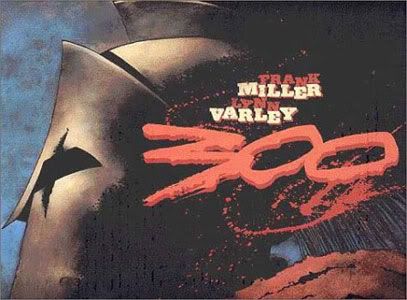
300 by Frank Miller and Lynn Varley


Well, it's been a long while since I last posted anything, but I assure you that's because I was too busy doing worthwhile things like rediscovering the joys of Diablo II. But anyway, I'm back, and this time I'm going to take on the task of trying to get to the meaning behind the meaning of the book and movie 300. I'll clarify what I mean eventually, but we have to get some things out of the way first.

First, I liked the book. I enjoy most of Frank Miller's well-known works such as Sin City, Ronin and Batman: The Dark Knight Returns. Second, I loved the movie. It's ridiculous how much I loved the movie. That being said, from here on out I am neither criticizing the book nor apologizing for it. I'm going to try to analyze it without succumbing to a knee-jerk reaction to see it as an insulting, racist, homophobic allegory or as a meaningless ode to the ultimate masculine ideal. In truth, it may be a bit of both, but we'll get to that.

I'm going to assume familiarity at least with the movie on the part of anyone reading this blog. That will be sufficient to examine the book as well, given that the movie is a stated attempt at a shot-for-shot live-action version of the book. I'll begin with a look at the historicity of the book. This at least is historically accurate: s a small army of Spartan soldiers under King Leonidas I did indeed fight a huge Persian army at Thermopylae (literally "hot gates"). Other than that, the book deals with history pretty fast and loose. I will not even try to point out every instance of incorrectness, but I think a few examples will be instructive (and any scholars reading, please forgive my own inaccuracies). First, and perhaps most important, is the characterization of Spartan society as some kind of democracy, especially one where women are equal. There were three classes of Spartan society (setting aside the issue of women entirely): Spartans proper, Perioikoi (skilled labor but free) and Helots (basically slaves). There was a 7-1 ratio of Helots to Spartiates according to Herodotus. To make a long story short, the only reason Spartans were professional soldiers is because keeping the Helots oppressed was a full-time job that required the dedication of every single adult male Spartan to it. So, democracy? Not so much. Another example is that King Leonidas was only one of two hereditary kings, neither of whom had great authority over the state. That power was wielded by the Gerousia, a council of elders which the kings belonged to. And even then, any proposals from the Gerousia had to be voted on by the citizenry (adult males only, of course). Two more examples, briefly: homosexual activity was at the very least as normal for Spartans as any other Greeks of the time, and Leonidas did not lead his men to battle in defiance of his government, he led them under orders from the Ephors (those guys depicted as twisted freaks and perverts in the movie).

So what difference does it make, you may say. It's a movie based on a comic which is a wildly inventive telling of the story. Indeed, I have no problem with this. If you try to learn history from comics, don't be surprised when your history teacher deducts points because you talk about how The Immortals were mutants and the Spartans fought wearing no armor because the sight of their pecs made enemies afraid. I don't expect comics to tell us the true story, that's what history books are for. But as usual, some of the audience for the film read a deeper meaning into the story than was apparent to the rest of us. The question is, is there any justification to their interpretation of the film/book?

In the case of Zack Snyder, I don't believe he had any motive whatsoever except to make the coolest, most awesome action film he could. And as far as I'm concerned, he did. Whatever moral there was to the story, he had nothing to do with putting it there. Miller, on the other hand, is problematic. It's hard to argue he doesn't have some kind of agenda, especially based on this oft-quoted remark:

Nobody questions why we, after Pearl Harbor, attacked Nazi Germany. It was because we were taking on a form of global fascism, we're doing the same thing now ... It seems to me quite obvious that our country and the entire Western World is up against an existential foe that knows exactly what it wants.... For some reason, nobody seems to be talking about who we're up against, and the sixth-century barbarism that they actually represent. These people saw people's heads off. They enslave women, they genitally mutilate their daughters, they do not behave by any cultural norms that are sensible to us. I’m speaking into a microphone that never could have been a product of their culture, and I'm living in a city where 3000 of my neighbors were killed by thieves of airplanes they never could have built".


It's not readily apparent exactly who Miller is talking about, although based on the other brief part of the transcript you can read here it would not be unjustified to assume that he is condemning categorically any culture which is Islamic. Could he be speaking narrowly about the Taliban? Given that in the rest of the conversation he appears to be talking about the War on Terror in Bushian terms, no, I don't think so. Why it's helpful to that point of view for the enemy to be a vague, formless mass is a topic for another blog, but when it becomes necessary to actually identify any terrorists, the presumption is that they're Islamic Middle-Easterners (which happens to erroneously include such non-Arab people as Iranians and Afghanis).

But just because a person holds ridiculous, offensive, or just plain crazy personal beliefs is no reason to disparage their writing or even assume a hidden message espousing their political, religious, moral or whatever agenda. If that was the case I simply couldn't read Orson Scott Card or John C. Wright, but I happen to really like at least some of their work (and if I don't like anything it's mainly because I think it's not a good story). This is not to say that it doesn't happen. After all there is Ayn Rand and John Ringo (or so I hear, I haven't actually read any of his books). Not that it doesn't creep in now and again, but usually it's just not that blatant. What about Frank Miller then? It's hard to say. Perhaps some elements of his viewpoints do come through. Honestly, the book and movie seem more like an homage to flawless male bodies than anything else. For all the dribble about "free men" and tyranny, there's not much dialog that really tries to persuade the reader of anything. Far more important are the depictions of death on a massive scale and the rending of flesh on a much more personal level. The violence is so excessive and over the top compared to just about anything else you'll see in a comic that the overt message can't be anything but simply "enjoy violence!" Second to that is the glorification of these perfect warriors, these iconic men of iron will and iron thews, the crimson-clad Spartans. It's not simply that the Spartans are glorified, it's that, if anything, they are held up as the model for all manhood. Seriously, this movie is a love song to perfect abs and that most male of sports, war.

Then again, there is much dialog devoted to the supposed clash of civilizations. That is, on the one hand, the Western Greeks with their logic and philosophy and dedication to (semi)democratic governance and on the other hand the Eastern Persians with their magic, superstition, and tyranny. Now seeing this in the context of Miller's view of the modern conflict of civilizations, it is truly hard not to make a connection.

Is there a parallel between Persia in Miller's 300 and modern Islamic terrorists? That can be, and should be, divided into two different questions. If there is a parallel, is it deliberate or not? And if there is not a parallel, then why are the Persians depicted as freaks, degenerates, barbarians, and perverts? Others have drawn their own conclusions about this (read opinions here and here). There are some good points about the issue to be found in the writings of others, but I just feel that stating that Miller's is a world where white = good and dark = bad is just too simplistic. The Greeks are not, as some might like to say, "white" and especially are not Aryan white. They are depicted as lighter than the Persians, which may be accurate in some cases, but given the lax treatment history gets from Miller, I actually wouldn't be surprised to find that he really thinks Persians were Arabic or something.

So is there deliberate racism in this book? I don't know that there's any clear answer to that. It would seem, based on his own comments, that Miller subscribes to some of the modern stereotypes blithely asserted about the Muslim/Arabic/Middle Easter world by ignorant right-wingers. I also suppose it depends on what one defines racism as these days. Beginning several hundred years ago, it was commonly accepted that there were biological differences between groups of people, even though the science of biology was crude and they couldn't really understand why some people were darker or lighter. These races were based on such external features as skin color, hair type, eye shape, etc, but also consisted of internal features such as temperament and intelligence. This was not the basis for discrimination against African-Americans in the US, but provided a handy explanation. Now, of that kind of racism I don't think exists much anymore. However, plenty of people still hold onto stereotypical beliefs about the other "races" and unfortunately don't think to question the validity of those beliefs. I think Miller falls into that category: racist in the fact that he basically stereotypes an entire ethnicity.

But to bring that back to 300: is 300 Miller's racist manifesto against the Arab people? I don't think so. I think 300 reflects his ideas of civilization against barbarism. Cultural sophistication versus depravity. Knowledge and learning versus superstition. And I think that he has an ideal of civilization that doesn't exist, either in those times of the Greeks that he writes about or in modern day Europe or America. Unlike another author who would deliberately choose to oversimplify the protagonist and antagonist just to make a better story, Miller seems to believe that things are or were this way, which makes it easy for him to laud one side and vilify the other. Still, it must be said that as an author he surely understands that the more conflict there is, the better, and so he deliberately exaggerated the goodness and badness of either side. The fact that it happens to bear some resemblance to his conception of real life may not be entirely coincidental, but I'm sure that the demands of the storytelling were sufficient enough reason for him to shape his narrative in the way that he did.

Ok, that's a big sloppy mess of writing on my part, for which I apologize, but at least I finally got it done. All thoughts and comments are welcome.